Private William Richard Eveleigh

This is part of a series of essays about the First World War casualties commemorated by the Commonwealth War Graves Commission in New York.
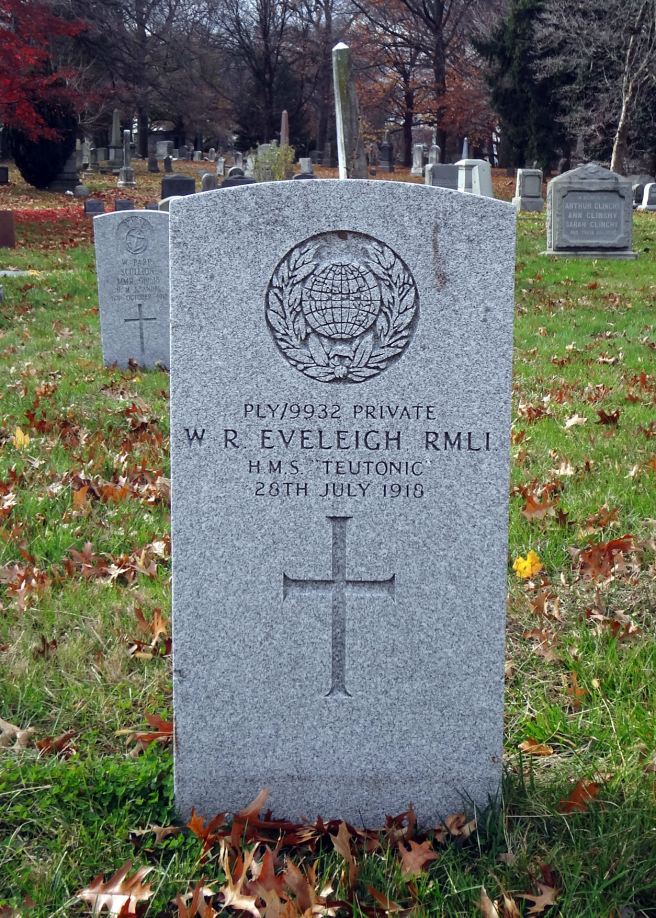
The grave of Private William Richard Eveleigh

William Richard Eveleigh was born on 29 June 1881 at Dartington near Totnes in Devon, the sixth of the ten children of John and Harriet Eveleigh.[1] The family moved to Rattery in 1892. His father and brothers were farm labourers and that is how William Eveleigh was employed until he enlisted into the Royal Marine Light Infantry at Totnes on 28 August 1899. He was allocated the number 9932.
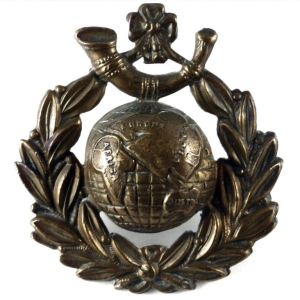
The badge of the Royal Marine Light Infantry

After his recruit training at the Depot at Deal, he finished his training as a ship’s gunner at Plymouth and joined the cruiser HMS Niobe on 10 December 1900—she acted as an escort for troopships at the latter stages of the South African War but he joined the ship too late to receive the Queen’s South Africa Medal. After a period ashore at Devonport he then served almost continually with the Fleet, interspersed with brief periods ashore.

Continue reading
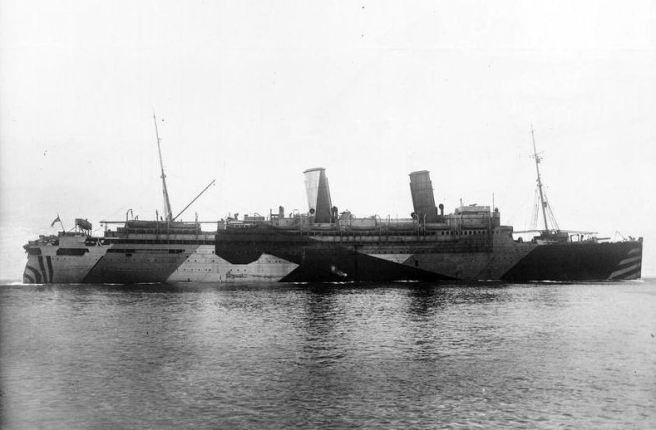
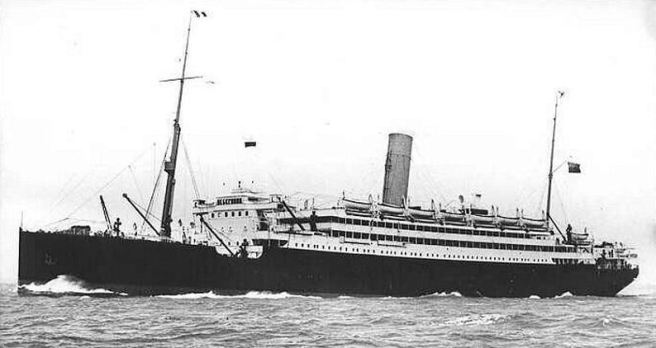
HMS Alsatian

This is part of a series of essays about the First World War casualties commemorated by the Commonwealth War Graves Commission in New York.

Trimmer Walter John Joseph Bowles, Mercantile Marine Reserve
Trimmer Percy Samuel Tomas Hyett, Mercantile Marine Reserve
(and Trimmer Leslie James Thornton, Mercantile Marine Reserve)

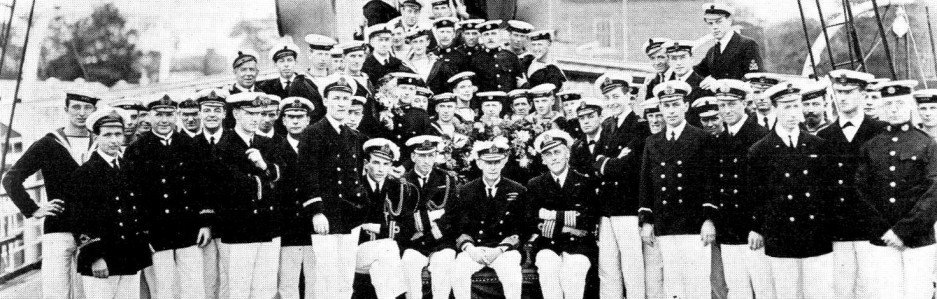
HMS Alsatian
HMS Alsatian

Two teenage sailors of the Mercantile Marine Reserve—Trimmers Bowles and Hyett—died while HMS Alsatian was alongside in New York during the influenza epidemic in October 1918. A third teenage sailor, Trimmer Thornton, had died as the ship was approaching the United States; he was buried at sea and, for completeness, his story is included here. This story is linked with that of the men of HMS Andes.

Continue reading

HMS Andes

This is part of a series of essays about the First World War casualties commemorated by the Commonwealth War Graves Commission in New York.

Able Seaman Thomas Drinkwater, Royal Navy
Leading Seaman William Stephen Charles Henry Fenton, Royal Navy
Scullion William Bertram Parr, Mercantile Marine Reserve
(and Private Reginald Francis Farley, Royal Marine Light Infantry)

HMS Andes
HMS Andes

In October 1918 two armed merchant cruisers—HMS Andes and HMS Alsatian—came alongside within days of each other and tied up at Pier 95 on the Hudson River near 55th Street. One crewman from HMS Alsatian had died as she approached the United States and a Marine in HMS Andes would die as she left United States waters. While the ships were in New York, five other crewmen died. All were victims of influenza.

Continue reading

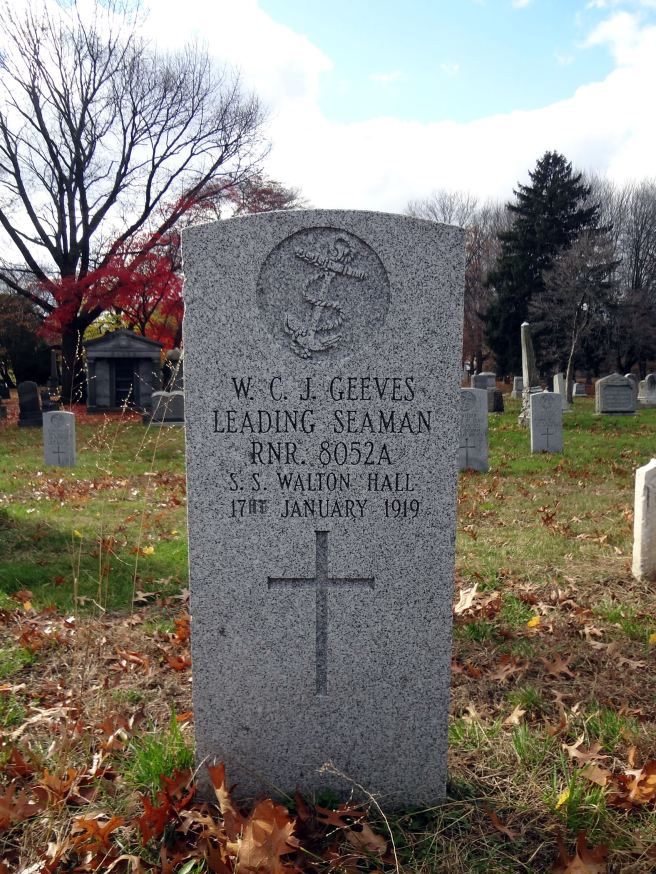
Leading Seaman William Charles John Geeves

This is part of a series of essays about the First World War casualties commemorated by the Commonwealth War Graves Commission in New York.

The grave of Leading Seaman William Charles John Geeves

Leading Seaman Geeves survived 3½ years as a gunner on defensively armed merchant ships, including the sinking of the cargo streamer SS Betty by U-61, only to succumb to influenza in New York.

William Charles John Geeves was born in London on 3 December 1889 the second son and second of the seven children of Charles and Eliza Geeves.[1] The family lived at New Beckton, Woolwich, where his father, who was born in Kingstown (now Dún Laoghaire) in Ireland, worked as a dock labourer. William Geeves became a merchant seaman.

On 15 April 1915, William Geeves enrolled in the Royal Naval Reserve and was allocated the number 8052A. After a period of training at HMS Pembroke in Chatham he joined SS Tuskar, a small, defensively armed cargo ship, on 19 May.

Continue reading

A Stranger in a Strange Land ‘

That old phrase describes the seaman who dies in New York, who lies alone in the hospital, or sometimes in the Institute. He turns to us when the end is near, confident that to us he is not a stranger, that what is left when he no longer can worry or arrange, will be reverently cared for.’[1]

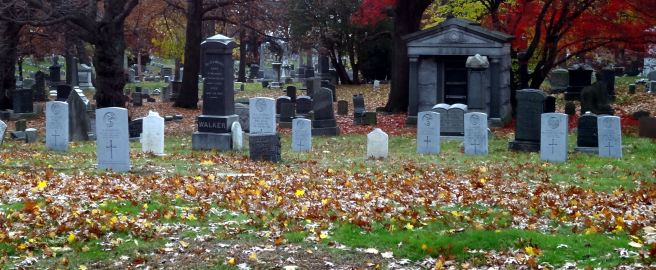
Seamen's Church Institute Plot, The Evergreens Cemetery, Brooklyn

The Seamen’s Church Institute plot in the Evergreens Cemetery, Brooklyn, has the second largest number of First World War CWGC graves in a single plot in the United States—the largest, with 10 men of the Royal Flying Corps and one from the Royal Air Force, being in Greenwood Memorial Park, Fort Worth, Texas.[2]

There are nine CWGC burials in the plot:

Trimmer Walter John Joseph Bowles, Mercantile Marine Reserve
Able Seaman Thomas Drinkwater, Royal Navy
Private William Richard Eveleigh, Royal Marine Light Infantry
Leading Seaman William Charles John Geeves, Royal Naval Reserve
Trimmer Percy Samuel Tomas Hyett, Mercantile Marine Reserve
Able Seaman Patrick McDonagh, Royal Naval Reserve
Stoker 1st Class Henry John Gardner Miller, Royal Navy
Scullion William Bertram Parr, Mercantile Marine Reserve
Stoker 1st Class Alfred Weeden, Royal Navy

The history of ministries serving the needs of merchant sailors on the eastern seaboard of the United States began in Boston in the period after the war of 1812 with the founding of the Boston Society for the Religious and Moral Improvement of Seamen. Similar ministries were founded in New York—the Marine Bible Society in 1817, and the New York Port Society in 1818.

Continue reading

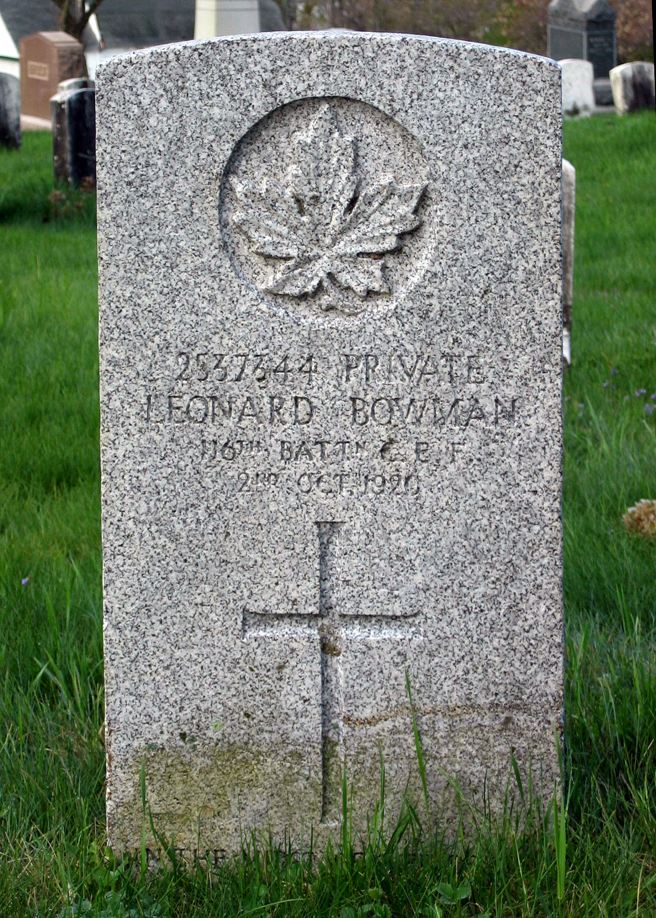
Private Leonard Bowman

This is part of a series of essays about the First World War casualties commemorated by the Commonwealth War Graves Commission in New York.

The grave of Private Leonard Bowman

In the village of Liberty in Sullivan County, New York, just prior to Remembrance Day 1921, a ‘Soldiers’ Circle’ was proposed by Liberty Cemetery Association. It was proposed particularly for ‘those veteran dead who have no families or friends to give them a fitting burial place ’.[1]  One of the first soldiers to be buried there was Private Leonard Bowman, an Englishman, who had been wounded serving in France with 116th Battalion in 3rd Canadian Division.

His family name was, in fact, Bouman—his father, Bernard, was Dutch and worked as a ladies’ tailor in London. Leonard was born in West Hampstead on 4 September 1887, the fifth of the seven surviving children of Bernard and his wife Sarah.[2]

Continue reading

Remembrance Day 2015 – Laurel Grove South Cemetery, Savannah

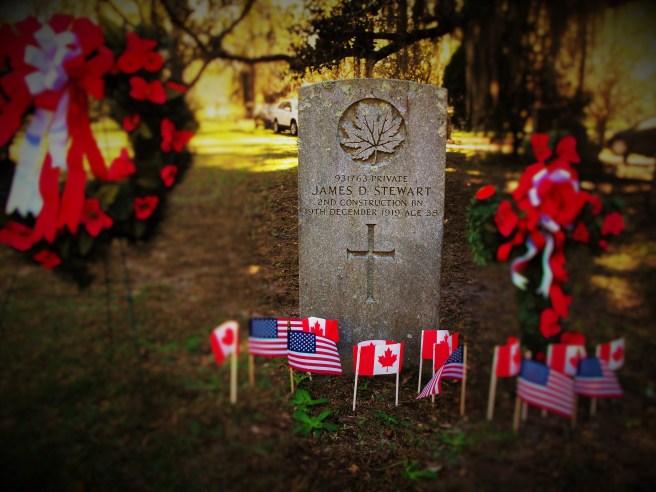
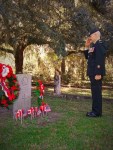
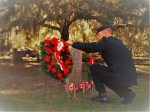
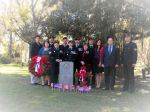
The grave of Private James Stewart, 11 November 2015

On Remembrance Day 2015, the Canadian Armed Forces contingent stationed in the United States at Fort Gordon, Georgia, held an act of remembrance at the grave of Private James Stewart.

Private Stewart was an African-American from Savannah, Georgia, who enlisted for service with the Canadian Expeditionary Force and served with No.2 Construction Company attached to the Canadian Forestry Corps in the Jura region in south-east France, and at Alençon in northern France. He died in Canada on 19 December 1919 and was buried in  Laurel Grove South Cemetery, Savannah four days later.

The event was organised by Corporal Allan Gudlaugson and the photographs were taken by Marie-Carole Gallien.

Lieutenant Robert Archer Bowlby

This is part of a series of essays about the First World War casualties commemorated by the Commonwealth War Graves Commission in New York.

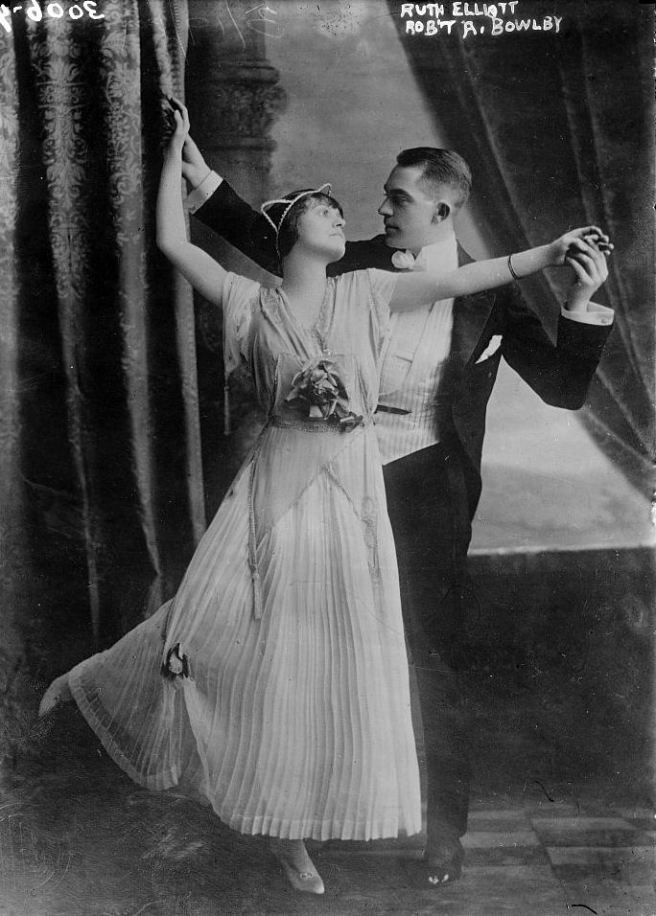
Miss Ruth Elliott and Robert Archer Bowlby

Robert Archer Bowlby is one of two American dancers to feature in this project—the other, much more famous, is Vernon Castle, who is buried in the same cemetery in New York. There are numerous newspaper reports, and records of talks given by Lieutenant Bowlby, that testify to his war service in France, his shell shock and subsequent role in support of the War Bond drives in the United States. His service was more prosaic, however—he made it to England before falling sick and being diagnosed with a heart condition, which resulted in his return to Canada and discharge.

Continue reading

Lance Corporal Edwin Otterson Baker

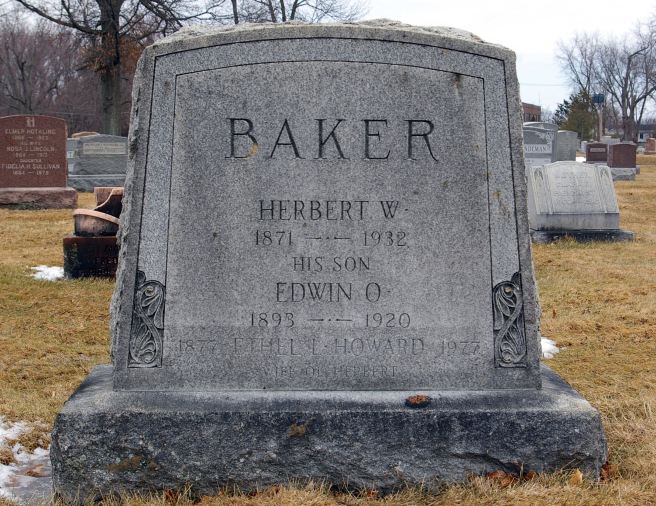
The grave of Edwin Otterson Baker
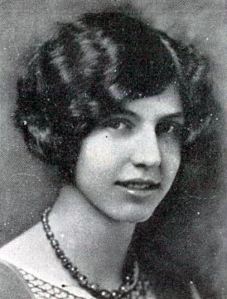
Barbara Alice Baker
Barbara Alice Baker

Edwin Otterson Baker was born at Roanoke, Virginia on 12 October 1893,[1] the son of Herbert Baker and his first wife.[2] His mother had died by 1900 and his father subsequently remarried, Ethel Howard, on 24 June 1903. The following year the family emigrated to Canada, settling initially in Portage la Prairie, Manitoba, where his younger half-sister, Barbara, was born in 1907.[3] By 1911 the family were living in Ottawa. Edwin later moved to Montreal, where he worked for a grocer.

He enlisted on 8 April 1916 in Montreal for service with the Canadian Expeditionary Force. For one reason or another he decided to conceal both his real name and his place of birth. He gave his name as Edward Oliver Brownlee and his place of birth as Portage la Prairie. He joined the 148th Battalion and was allocated the regimental number 842021. The Battalion, comprising 32 officers and 951 other ranks, sailed from Halifax on RMS Laconia[4] on 26 September 1916 arriving in England on 6 October and on that day he was promoted to Lance Corporal.

Continue reading