Update, October 2022: The commemoration record for Corporal John. H Dorman, United States Army has now been removed from the Commonwealth War Graves Commission website.
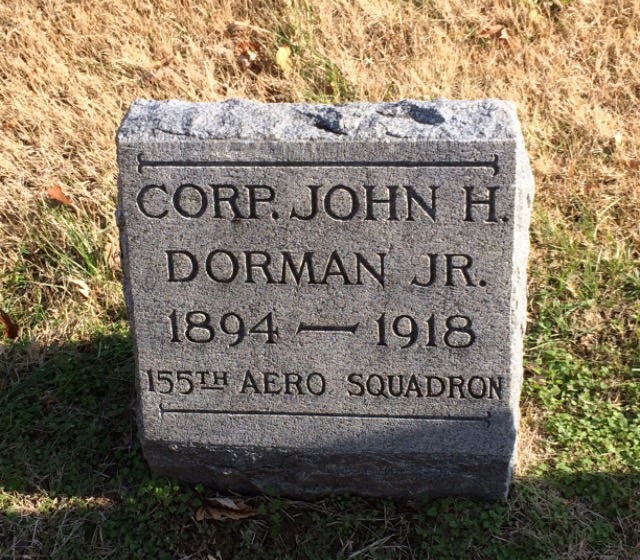
Several years ago, an airman called John Henry Dorman was accepted for commemoration by the Commonwealth War Graves Commission. Dorman had been killed in an accident on 21 June 1918 while training at No. 14 Training Depot Station, at RAF Lake Down near Amesbury. The conclusion was that he was Royal Air Force, one of the many Americans who had earlier joined the Royal Flying Corps or Royal Air Force. When I first added his name to the project, I carried out some cursory research and was left with some doubts about this conclusion. Prompted recently to dig further, I am now left with the verdict that he was not Royal Air Force but was, indeed always had been, a member of the Aviation Section of the United States Army Signal Corps serving with 155th Aero Squadron.
This is part of a series of essays about the First World War casualties commemorated by the Commonwealth War Graves Commission in Massachusetts.
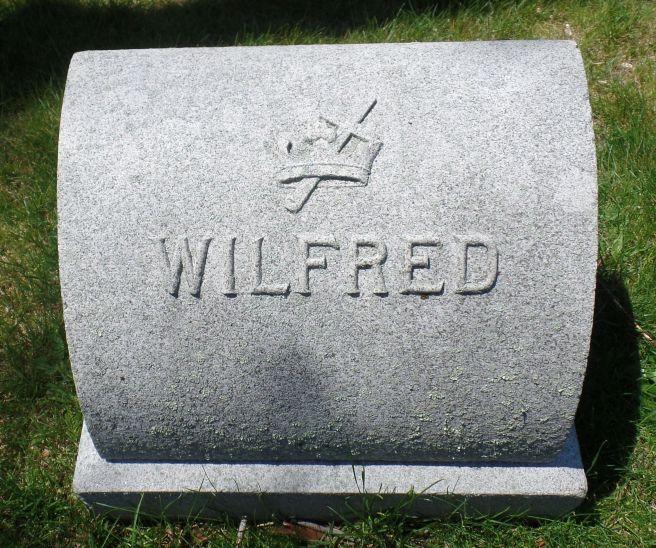
The grave of Wilfred Cecil Alcock
Newspaper report
The weekend of 24 November 1917 saw a series of accidents at the training airfields that made up Camp Taliaferro near Fort Worth in Texas. The newspapers of the day carried lured stories of multiple fatalities and mortally wounded aviators (see the linked example) but the truth is somewhat simpler to recount. On Saturday 24 November Cadet Wilfred Alcock crashed into the undercarriage of another Curtis JN4 flying in formation and was killed instantly. The other pilot, Royal Flying Corps Cadet James Harold Thompson, crash landed and was injured but recovered. Another crash involving Cadet Eric Biddle was not the fatal event that the newspapers reported, and neither was that of Cadet Brailey Gish, although they were injured. A second fatality occurred on Monday 26 November when newly commissioned Second Lieutenant Frank Park Mathews fell in his aircraft from 2,500 feet. Only Alcock was British; Thompson was born in Canada but lived in the United States and Biddle, Gish and Mathews were Americans, the latter two being pilots of the Aviation Section, United States Army Signal Corps.[1]
This is part of a series of essays about the First World War casualties commemorated by the Commonwealth War Graves Commission in New York.
Leading Seaman Gordon Wills
Sam Gordon Wills was born on 5 March 1887, the second of the six children of Francis and Harriet Wills, at South Town, Kenton, near Dawlish in Devon, where his father was a farm labourer.[1] By 1901 he was working as a yard boy for a family in Dawlish.
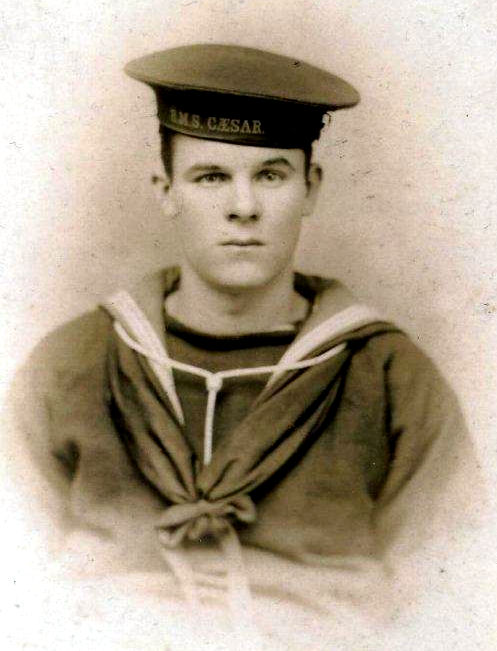
He enlisted into the Royal Navy at Devonport on 18 April 1906 and was numbered SS/1368—during his service he was known as ‘Gordon’.[2] After a short period of training ashore, he joined the crew of the battleship HMS Vengeance in the Channel Fleet. His second ship was another pre-dreadnought battleship, HMS Caesar, from June 1908 to May 1909, and he then joined the dreadnought HMS Temeraire. He was transferred to the Royal Naval Reserve on 29 April 1911.
This is part of a series of essays about the First World War casualties commemorated by the Commonwealth War Graves Commission in New York.
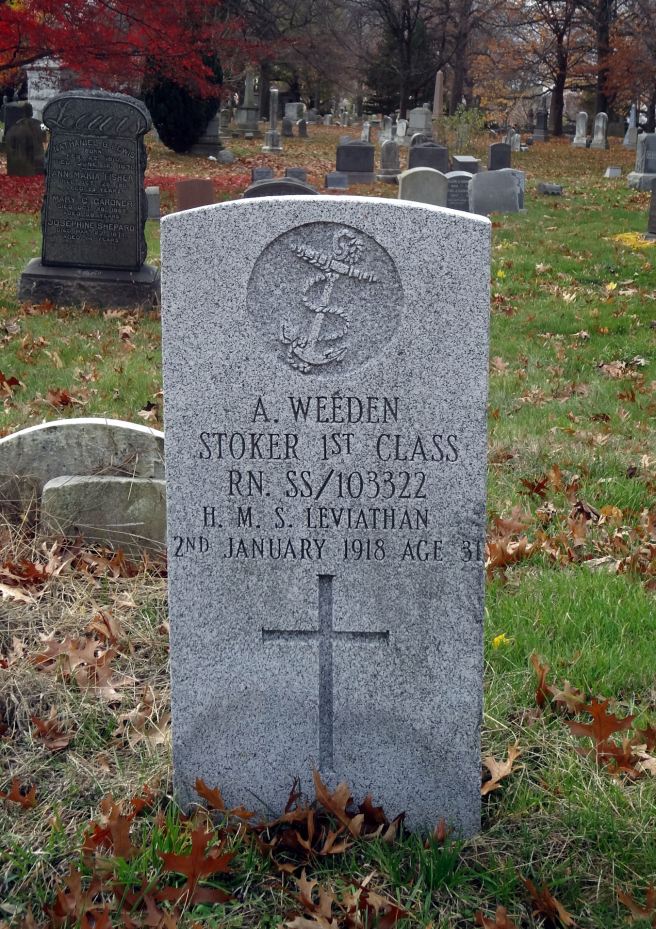
The grave of Stoker Alfred Weeden
Although recorded as being on the crew of HMS Leviathan, in fact, Stoker Weeden died in an accident in New York while serving in HMS Charybdis, which was undergoing conversion to a passenger and cargo carrier.
Alfred Weeden was born at Farnham in Surrey on 25 December 1884,[1] one of the twelve children of George and Mary Weeden.[2] When he left school he became a bricklayer’s labourer before he enlisted into the Royal Navy on 2 July 1906.[3]
After a period of training ashore and afloat at Portsmouth, Stoker Weeden joined the armoured cruiser HMS Drake. He remained in Drake, other than for periods of training ashore, until July 1909, when he was posted to various training establishments on the south coast. He transferred to the Royal Fleet Reserve on 2 July 1911.
This is part of a series of essays about the First World War casualties commemorated by the Commonwealth War Graves Commission in New York.
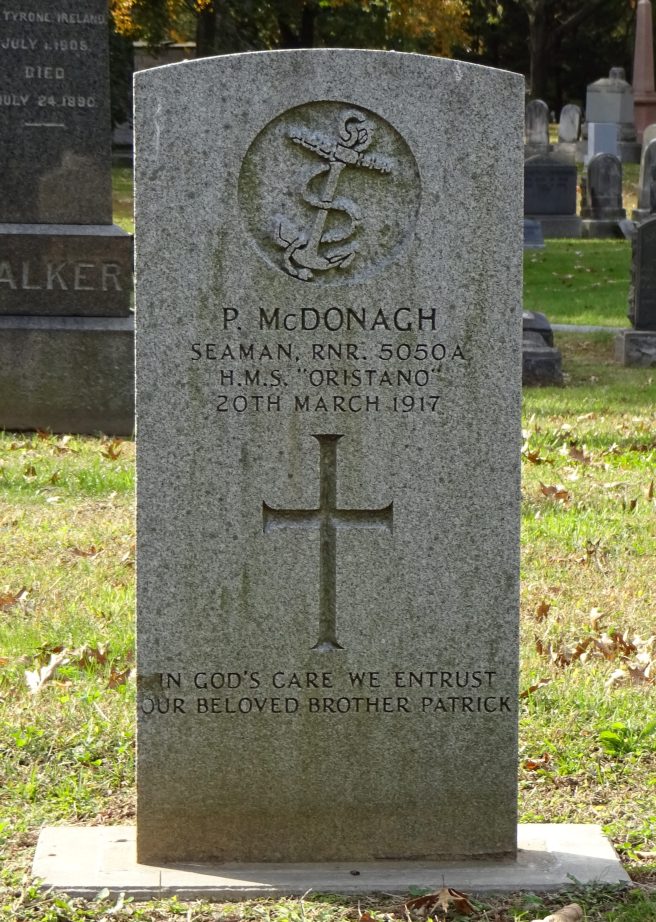
The Gravestone of Able Seaman Patrick McDonagh
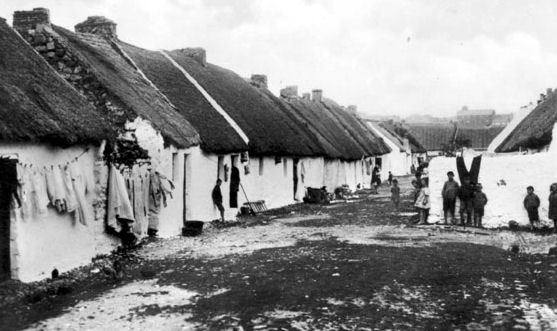
Patrick McDonagh (Padhraig MacConnachadh[1]) was born on 16 March 1895 in Claddagh, a fishing village on the western outskirts of Galway in Ireland. He was the fourth of the nine children of Thomas and Kate McDonagh, who lived at Rope Walk in the centre of the village.[2] His father was a stone mason but Patrick became a fisherman, like the majority of men in the village.
Claddagh in the early 20thC
He enrolled in the Royal Naval Reserve on 20 June 1913 and was allocated the number 5050A. Between August and November he underwent training at Portsmouth and in the gunnery training ships HMS Duncan and HMS Albemarle, and in the Home Fleet in the battleship HMS Bulwark. In the period before the war he returned to Galway, initially fishing as a crewman on the trawler Star of the Sea, before joining the liner SS Merion for a crossing to Philadelphia, and then the White Star liner SS Suevic for a journey to Australia between March and July 1914.
This is part of a series of essays about the First World War casualties commemorated by the Commonwealth War Graves Commission in Louisiana.
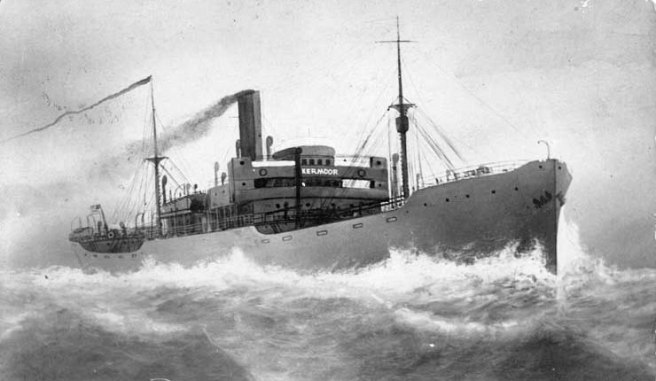
SS Kermoor, commissioned as the USS Kermoor
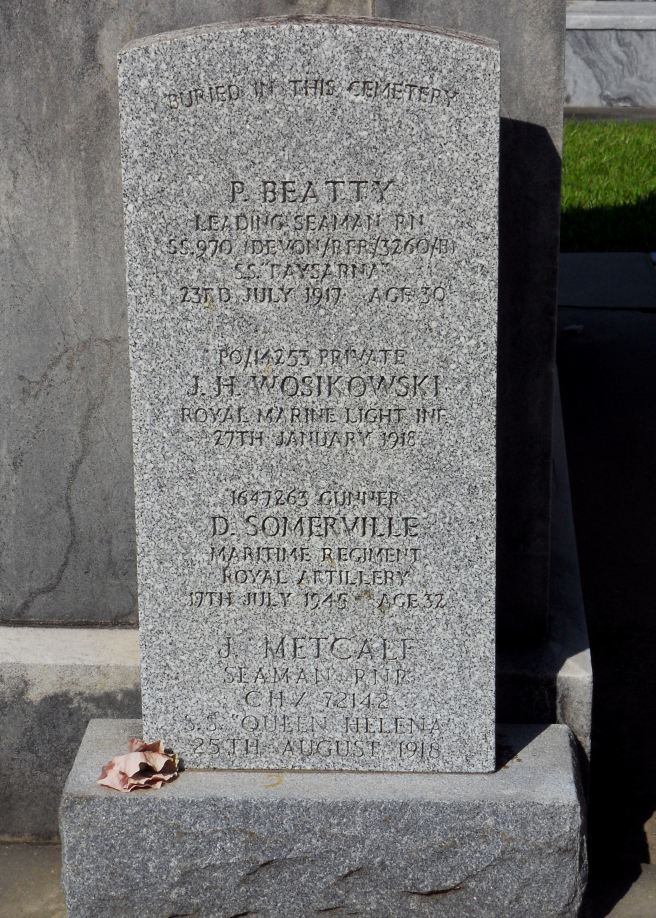
Joseph Wosikowski was born on 10 June 1887 at St Marys, Southampton, the second son of Frank and Sarah Wosikowski.[1] His father was a Polish immigrant from Altjahn in West Prussia,[2] and his mother was from County Down in Ireland. His father and his elder brother were sausage skin dressers and his sister worked as a domestic servant. Joseph trained as a butcher with his father before enlisting into Royal Marine Light Infantry on 27 July 1905.
This is part of a series of essays about the First World War casualties commemorated by the Commonwealth War Graves Commission in Louisiana.
Editor’s Note: Some details about Leading Seaman Beatty were incorrectly recorded by the CWGC. His online record now reflects his correct date of death, service and ship and his gravestone will be replaced.
The war memorial at Chester Cathedral
When the war memorial was unveiled at Chester Cathedral on 24 May 1922, two mothers played a central role in the ceremony—Mrs Lydia Sheriff Roberts who had lost three sons in the war and Mrs Mary Beatty who had lost four.[1]
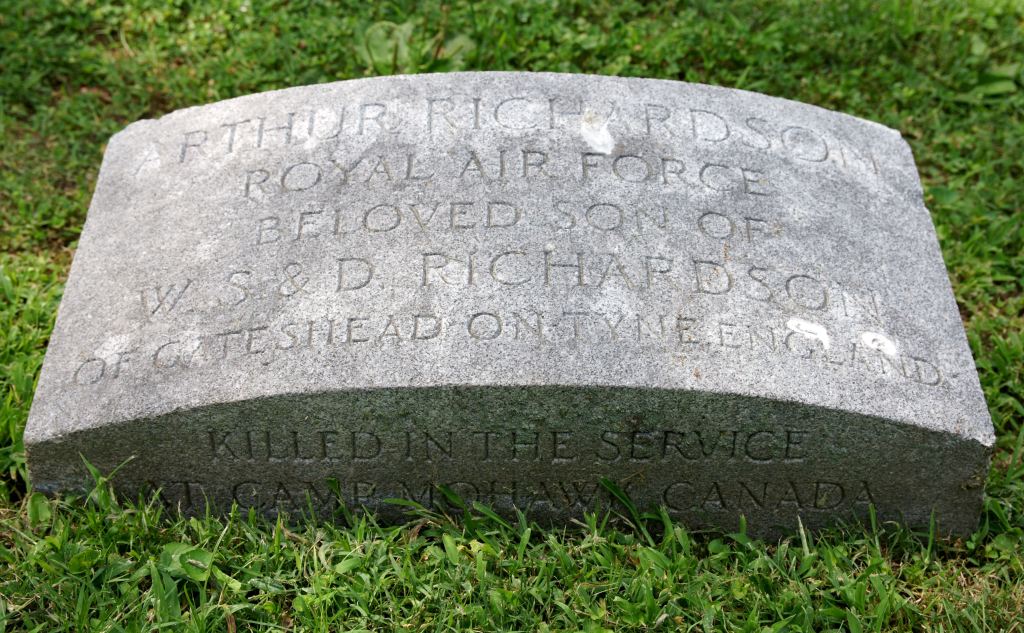
Cadet Arthur Richardson was an English-born accountant working in St Louis, Missouri when he enlisted into the newly formed Royal Air Force in Winnipeg, Manitoba on 11 April 1918.[1]
This is part of a series of essays about the First World War casualties commemorated by the Commonwealth War Graves Commission in Maryland.
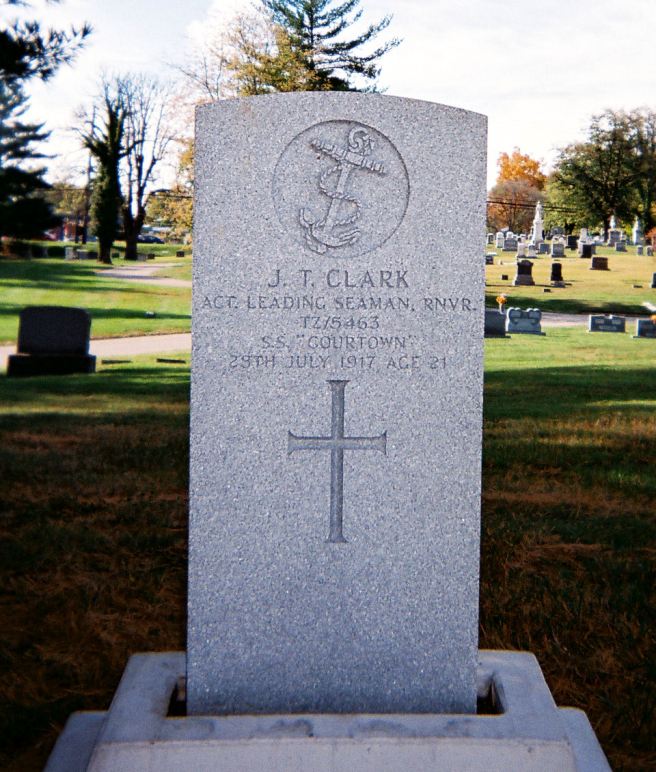
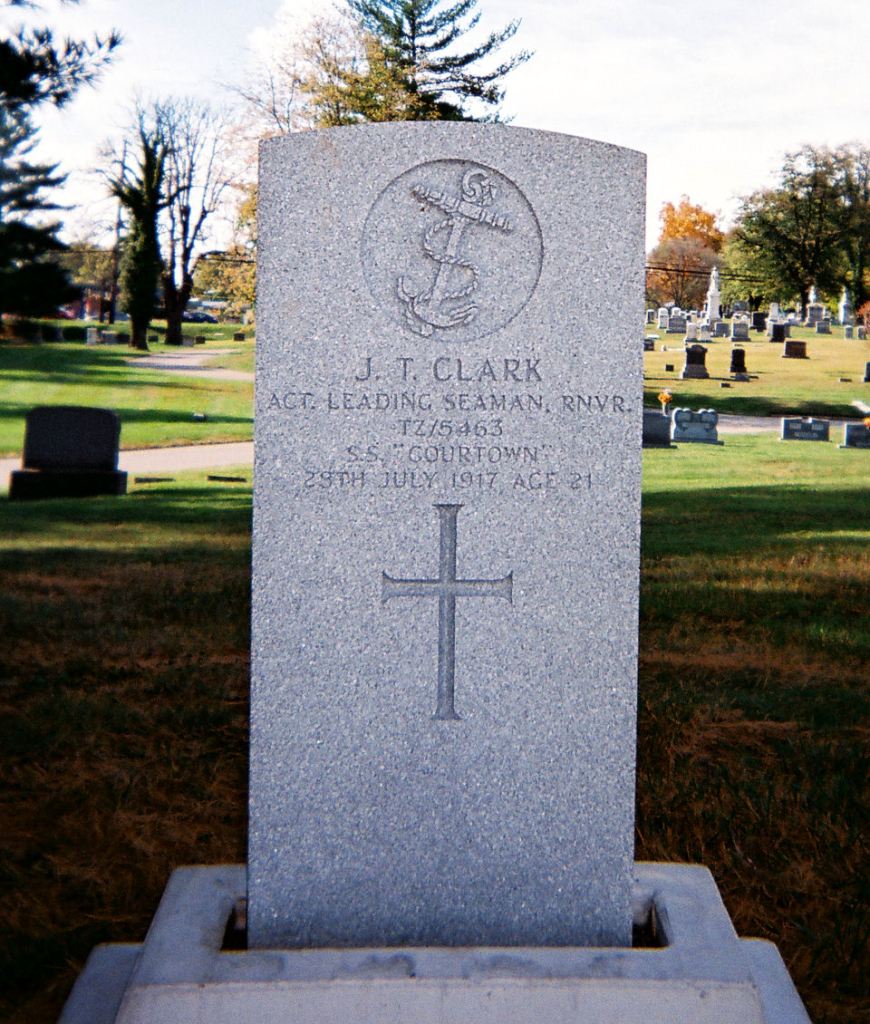
The grave of Leading Seaman Joseph Thompson Clark
Joseph Thompson Clark was nearby when HMS Natal blew up in Cromarty Firth in 1915, was present at the Battle of Jutland, and survived being torpedoed in the Mediterranean only to drown in a swimming accident in Baltimore harbour in 1917.
He was born on 26 August 1896 at Cowpen, near Blyth, an industrial town in Northumberland, one of the three children of Fergus and Mary Ann Clark.[1] His father had worked variously as a miner, a boiler fireman and as a crane driver. Joseph, like his older brother, worked in a sawmill.
Just after the outbreak of war, Clark enlisted on 21 August 1914 into the British Army at Newcastle-upon-Tyne (4903, Private) and joined the newly raised 8th (Service) Battalion, The Northumberland Fusiliers, the first of the New Army battalions raised for the Regiment. He falsely gave his age as 19. His early service was somewhat ill-disciplined and he was discharged on 30 October as ‘not being likely to become an efficient soldier’.[2]
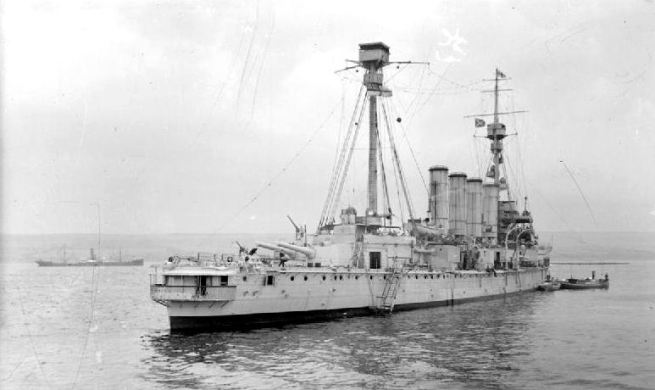
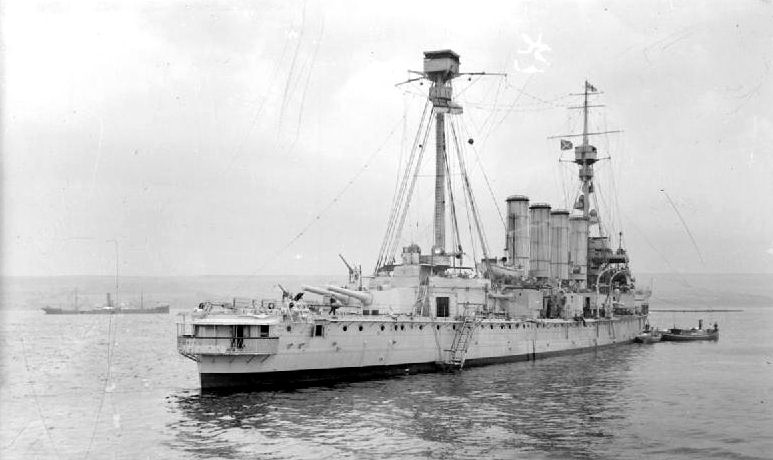
Clark then enlisted into the Royal Naval Volunteer Reserve on 23 June 1915, just before his 18th birthday—he again falsely stated his age, giving his birthday as 26 August 1895. He was allocated the number TZ/5463 and joined the training depot at Crystal Palace. After a period of training he joined HMS Shannon, a Minotaur-class armoured cruiser, on 30 September 1915. He was aboard her on 30 December 1915 when the armoured cruiser HMS Natal exploded nearby in Cromarty Firth with the loss of over 400 crew and civilian visitors—Shannon assisted in the rescue of the survivors.[3] Clark was also in HMS Shannon during the Battle of Jutland, although the ship did not see action that day.
HMS Shannon at Cromarty Firth, 1915
On 31 August 1916, Able Seaman Clerk reported for duty ashore for training as a gunner on defensively armed merchant ships; he completed this training on 9 November and, having found his niche, was appointed Acting Leading Seaman. When the story of Clark’s death appeared in the Baltimore Sun, it was reported that he had served on the SS Bretwalda, and had survived her sinking on 13 December 1916, when she was attacked by UB-43, 220 miles east of Malta on passage from Calcutta to Boulogne with a cargo of jute. It was reported that he spent several days adrift in a lifeboat before being picked up and taken to port in Italy. Soon after he joined the SS Courtown, a general cargo ship built in 1909.[4]
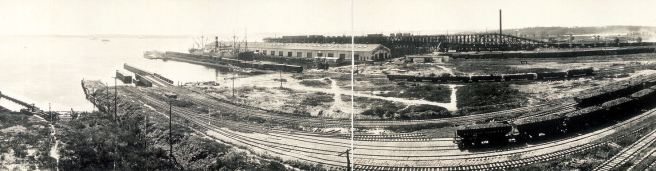
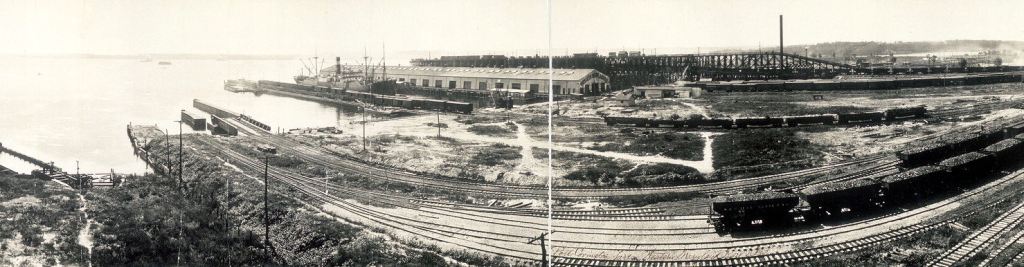
Acting Leading Seaman Clark arrived in the United States in July 1917 as the chief gunner on the Courtown, which berthed at the Western Maryland Railroad pier at Port Covington, Baltimore. On 28 July, after lunch he and his friends decided to go for a swim near the grain sheds. Clark could not swim and he wore a life-belt. He was accompanied by another gunner, Able Seaman Herbert Crawshaw,[5] and Radio Operator Cyril Matthews. Crawshaw had survived the explosion on HMS Natal—he was on the upper deck when the explosion occurred—and had trained as a gunner with Clark, completing his training on the same day; he too had served in SS Bretwalda before joining the Courtown.
Port Covington, Western Maryland Railroad Yards, 1913
Clark decided that he had had enough practice with the life-belt and took it off to try and swim without it. Crawshaw swam to him to give assistance if needed but, before he could reach his friend, Clark disappeared under the water. Crawshaw tried to grab him and felt him tug at his body but he did not return to the surface. The other men dived to try and find Clark but they were unsuccessful. Having told the ship’s Master about the accident, the police were informed and the police boat Lannan was dispatched to drag for the body; it was found a few hours later. The coroner, Otto M. Bernhard, recorded a finding of accidental drowning.[6]
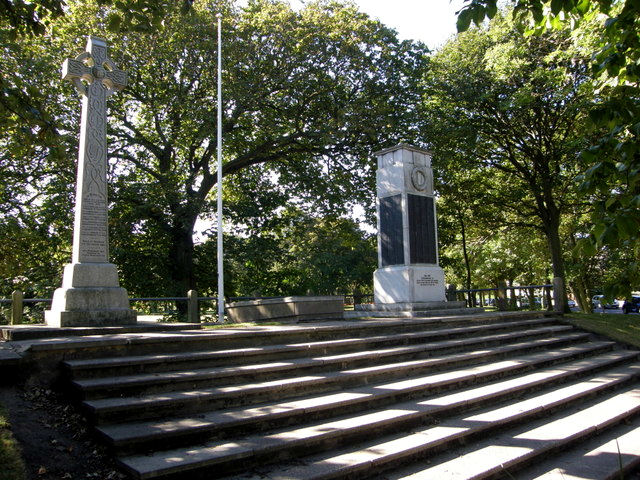
Acting Leading Seaman Joseph Thompson Clark was buried in Cedar Hill Cemetery, Baltimore, on 30 July 1917.[7] He is commemorated there by a Commonwealth War Graves Commission headstone. He is also commemorated on the Blyth war memorial.
Blyth War Memorial – the First World War memorial is on the right, the Boer War memorial is on the left
His medals group comprises: British War Medal 1914-20, and Victory Medal.
The grave of Acting Leading Seaman Joseph Thompson ClarkHMS Shannon at Cromarty Firth, 1915Port Covington, Western Maryland Railroad Yards, 1913Blyth War Memorial – the First World War memorial is on the right, the Boer War memorial is on the left
1. (Back) Fergus Clark (1863-1936) married Mary Ann Shirran (1867-NK) in 1885; James (1886-NK); and Isabella (1894-NK). Another sibling died in childhood. 2. (Back) His offences, mostly relatively minor, included absence overnight, gambling in barracks, smoking in the ranks, making an improper remark to an officer, talking in the ranks, and breaking out of detention while undergoing punishment. At this stage of the war, the Army could be selective with recruiting and Clark was discharged under King’s Regulation 392(iii)c: ‘Recruit within three months of enlistment considered unfit for service’. 3. (Back) A full account of the disaster may be found here: HMS Natal. 4. (Back) ‘Naval Gunner Drowned’. (29 July 1917). Baltimore Sun. p 14. This article contains a number of facts about Clerk’s service but it is evident when comparing it to his service record that they have been mixed up when recounted. 5. (Back) Able Seaman Herbert Wentworth Crawshaw was born on 9 July 1898 at Mirfield, Yorkshire. Prior to the war he worked as a miner. He enlisted on 15 March 1915 (numbered TZ/3981). Like Clark, he was underage and give his birthday as 9 July 1896. His career paralleled Clark’s and after his period on defensively armed merchant ships he served for the last nine months of the war in Gibraltar. He was demobilized on 1 May 1919. He died in Yorkshire in 1959. 6. (Back) Death Certificate. (30 July 1917). Health Department, City of Baltimore. Certificate number D7149. The certificate shows his name as ‘Joseph L. Clark’. 7. (Back) Plot E, Lot 172, Grave 11. The cemetery register incorrectly records his name as ‘James L. Clark’.



 Sacrifice