This is part of a series of essays about the First World War casualties commemorated by the Commonwealth War Graves Commission in Connecticut.
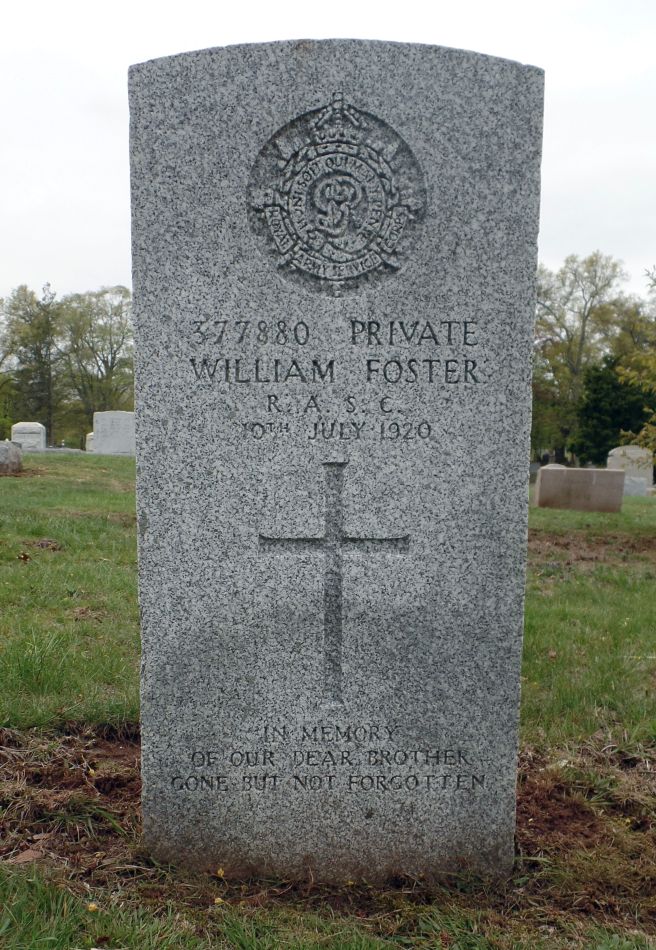
The grave of William Foster
William Foster was an Englishman and naturalised United States citizen, who had emigrated to the United States with his family before the war. Like many British men he returned home to enlist.
This is part of a series of essays about the First World War casualties commemorated by the Commonwealth War Graves Commission in Connecticut.
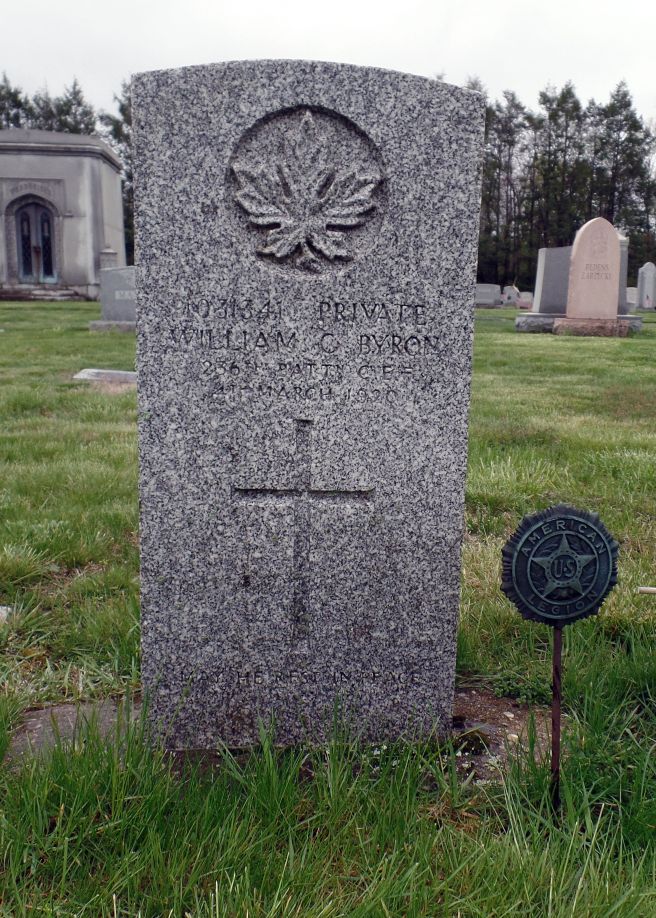
The grave of Private William Byron
William Christopher Byron was born in Almonte, Ontario on 27 June 1889 the son of Joseph and Nellie Byron.[1] His mother was Scottish; she emigrated to Canada in 1887 and settled in Ontario, where she married his father, a Canadian. His father died when William Byron was an infant.
This is one of two essays about the First World War casualties commemorated by the Commonwealth War Graves Commission in New Mexico.
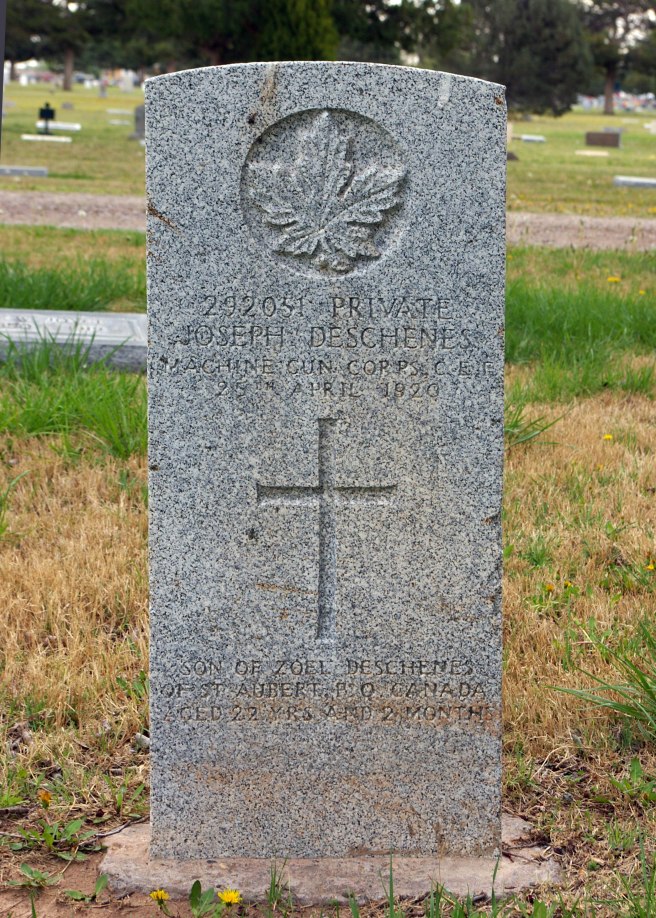
The grave of Joseph Deschenes
Joseph Honoré Deschenes was a French-Canadian born on 10 February 1898 at St. Aubert, Quebec the fourth of the nine children of Zoël and Clare Deschenes.[1] At the time of his enlistment he was working as a labourer in Letellier, a small Francophone community in Manitoba.
He enlisted on 20 December 1915 in Morris, Manitoba for service with the Canadian Expeditionary Force. When he enlisted, aged 17, he gave his year of birth as 1897, implying that he was two months short of his 19th birthday.
This is one of two essays about the First World War casualties commemorated by the Commonwealth War Graves Commission in New Mexico.
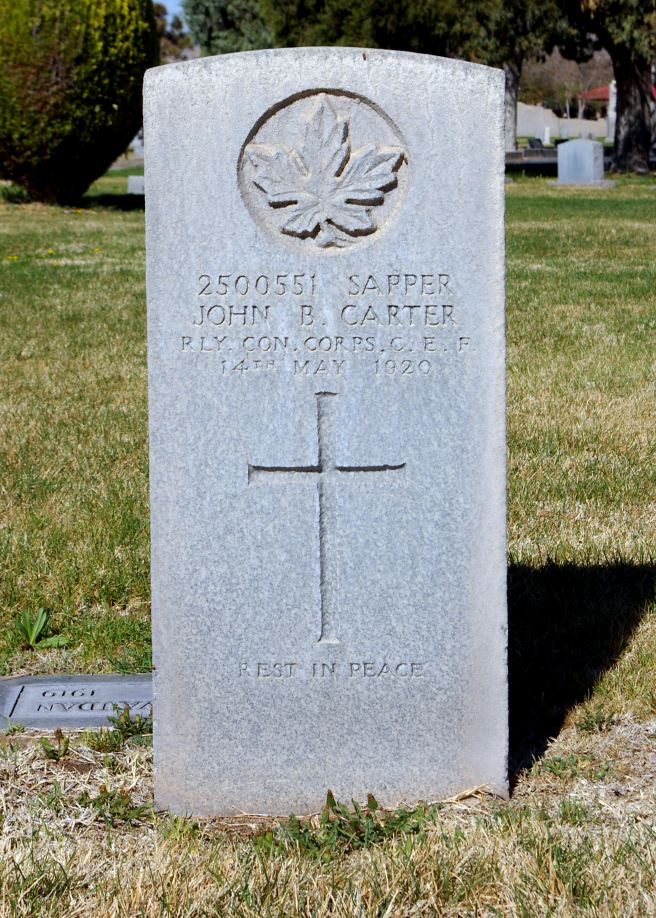
The grave of Sapper John Barton Carter
The details of the early life of John Barton Carter are difficult to determine but it is clear that they bear no resemblance to the information he provided on enlistment in 1918. He was probably born on 3 June around 1866, possibly in or near Albia, Iowa, the son of Thomas and Lydia Carter.[1] He worked in Albia as a tailor.
Carter enlisted on 8 May 1918 in Toronto. Like many citizens of the United States, he concealed his place of birth, giving it as ‘Toronto’ and he concealed his true age, giving his date of birth as 3 June 1878. He joined the Railway Construction and Forestry Depot at Hamilton, Ontario for his initial training and was allocated the number 250051.
This is part of a series of essays about the First World War casualties commemorated by the Commonwealth War Graves Commission in New York.
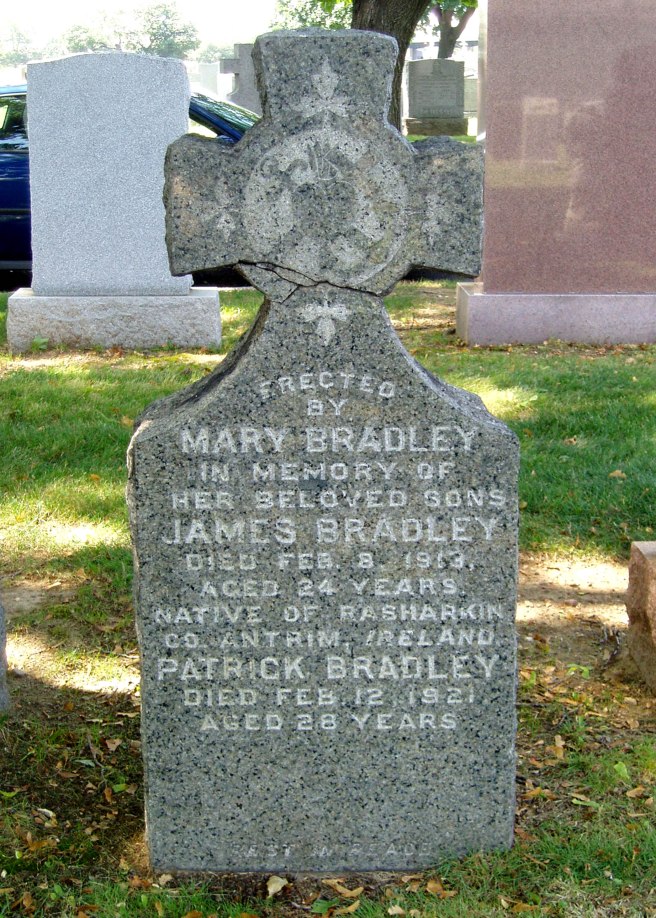
The grave of Private Patrick Bradley
Patrick Bradley was an Irishman who enlisted in early 1918 but fell ill soon afterwards and was discharged. He was born at Cushybraken near Kilrea in County Antrim, Ireland on 15 January 1893[1] the son of Charles and Mary Bradley.[2] His father was a farmer, who died before the turn of the century.
His mother emigrated to the United States around 1904 with his older brother James and settled in New York. Patrick remained in Cushybraken with his widowed maternal grandmother and his mother’s family. After he left school, he worked as a farm labourer. James returned to Ireland in 1909 and in January 1910 he sailed back to New York from Londonderry on the SS Furnessia with his brother Patrick. Both sons lived with their mother and Patrick found work in service. At the time of his enlistment he was a footman for Mrs Sterling Postley, who lived in a sumptuous apartment at 830 Park Avenue.[3]
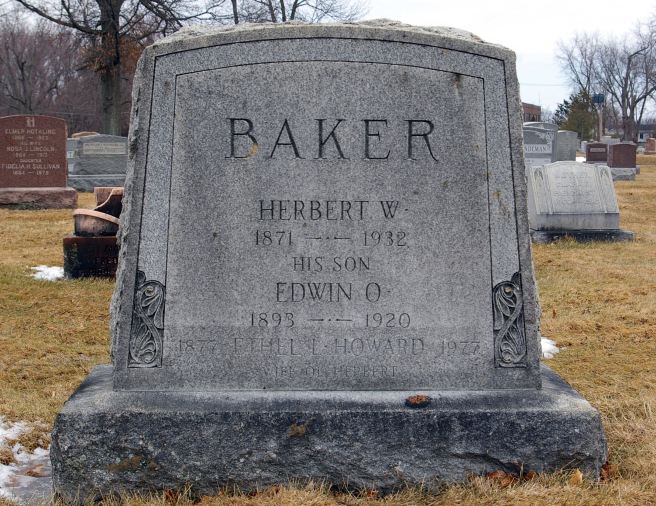
Edwin Otterson Baker was born at Roanoke, Virginia on 12 October 1893,[1] the son of Herbert Baker and his first wife.[2] His mother had died by 1900 and his father subsequently remarried, Ethel Howard, on 24 June 1903. The following year the family emigrated to Canada, settling initially in Portage la Prairie, Manitoba, where his younger half-sister, Barbara, was born in 1907.[3] By 1911 the family were living in Ottawa. Edwin later moved to Montreal, where he worked for a grocer.
He enlisted on 8 April 1916 in Montreal for service with the Canadian Expeditionary Force. For one reason or another he decided to conceal both his real name and his place of birth. He gave his name as Edward Oliver Brownlee and his place of birth as Portage la Prairie. He joined the 148th Battalion and was allocated the regimental number 842021. The Battalion, comprising 32 officers and 951 other ranks, sailed from Halifax on RMS Laconia[4] on 26 September 1916 arriving in England on 6 October and on that day he was promoted to Lance Corporal.
This is part of a series of three essays about the First World War casualties commemorated by the Commonwealth War Graves Commission in Tennessee.
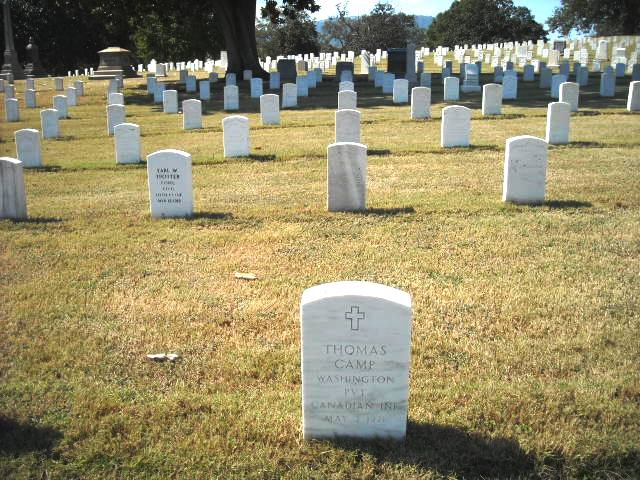
The grave of Private Thomas Camp in Chattanooga National Cemetery
Thomas Camp was an American of British descent born at Madisonville, Tennessee on 24 January 1896, the son of Charlie and Sallie (née Arp) Camp.[1] Little is known of his wider family but he worked as a baker and lived in Shooks Gap, a small settlement south-east of Knoxville.
He enlisted at Montreal on 6 February 1918 for service with the Canadian Expeditionary Force and joined the 1st Depot Battalion, Quebec Regiment, where he was allocated the number 3081869. Camp’s early service was spent in hospital until 15 May, when he was posted to Valcartier, the site of the largest training camp in Canada, to be employed as a baker.
This is part of a series of three essays about the First World War casualties commemorated by the Commonwealth War Graves Commission in Tennessee.
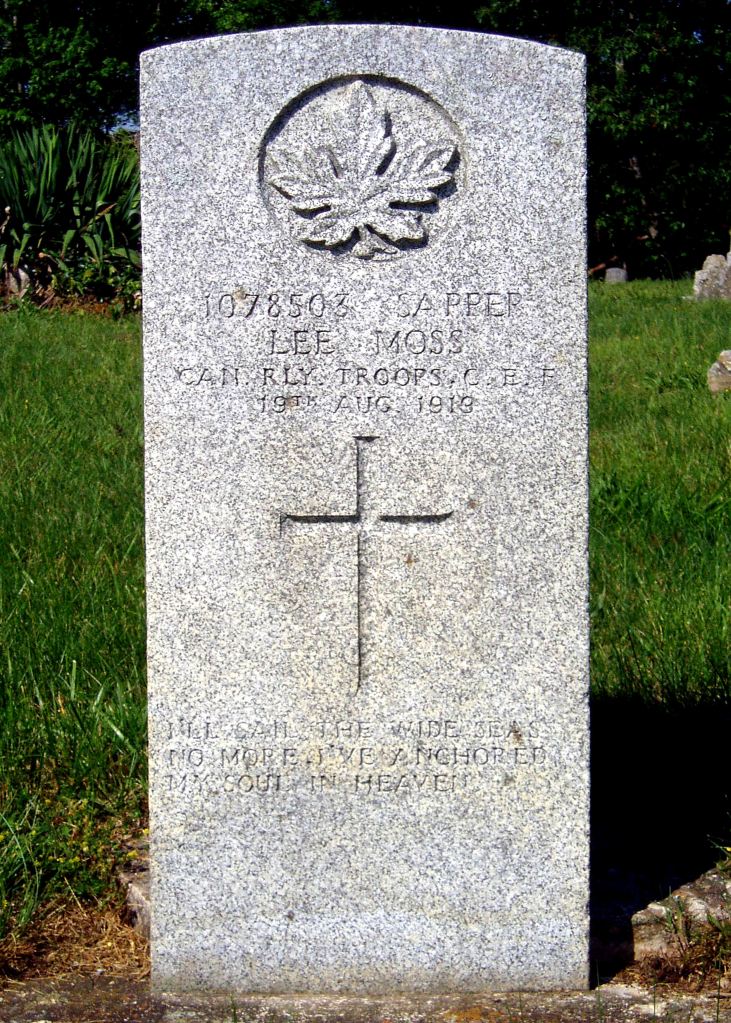
The grave of Private Lee Moss
Lee Arvel Moss was born at Vigor, a community near Athens, in McMinn County, Tennessee on 4 March 1887, the second of the five children and eldest son of Hugh and Cammie Moss.[1]
At the time of his enlistment he was living in Montreal and, although a blacksmith by trade, he was working as a steam fitter. He was a member of the Militia, serving with 4th Field Company, Canadian Engineers. He enlisted on 10 August 1916 for service with the 5th Pioneer Battalion, giving his year of birth as 1883, and was allocated the regimental number 1078503.
This is one of two essays about the First World War casualties commemorated by the Commonwealth War Graves Commission in Kentucky.
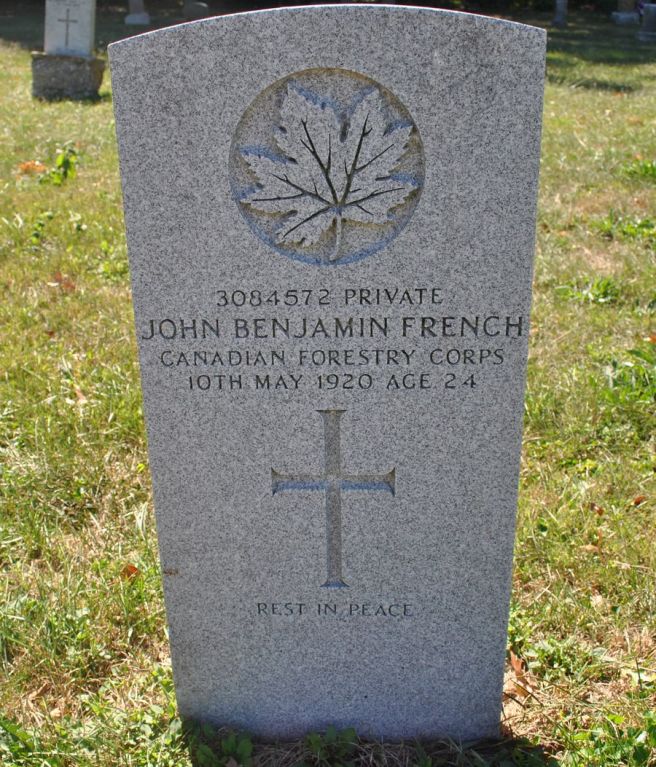
The grave of Private John Benjamin French – note the original gravestone behind
John Benjamin French was an African-American born on 22 July 1896 in Lexington, Kentucky, the son of Ash and Lula French of 325 Race Street.[1] Little is known of his family but John French was working as a ‘shoe shiner and jockey ’ when he enlisted in 1918.
This is part of a series of essays about the First World War casualties commemorated by the Commonwealth War Graves Commission in Ohio.
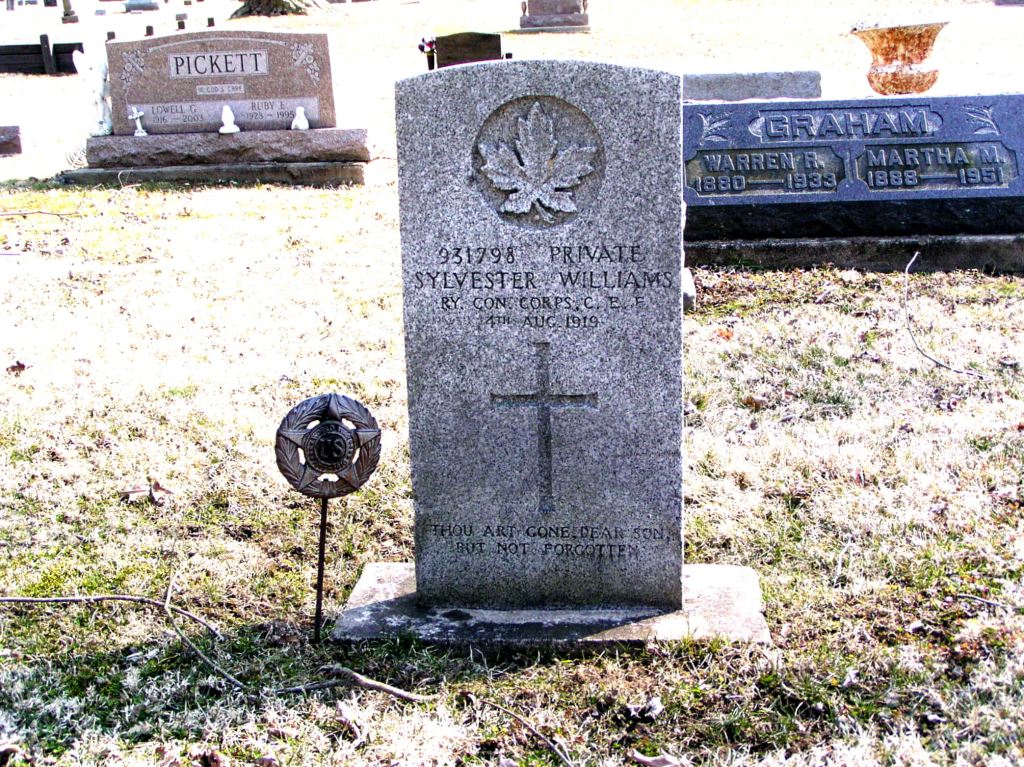
The grave of Private Sylvester Williams
Private Sylvester Williams was one of about 165 African-Americans—one of seven from Ohio—who served with No.2 Construction Company (Coloured) in the Canadian Expeditionary Force.[1] More information about this unit may be found in the story of Private James Doval Stewart.
Sylvester Williams was born on 19 April 1873, at Waynesville, Warren County, Ohio, to Augustus and Mary Jane Williams. His father, a farmer, was born in South Carolina and his mother was from Kentucky. Their children were all born in Ohio and only seven of their twelve offspring survived beyond childhood.[2]
At the time of his enlistment, he was working in Detroit as a brick paver, his occupation for the previous 18 years.[3] Being over-age when he enlisted at Windsor, Ontario on 8 February 1917 he falsified his age and gave his year of birth as 1881. He enlisted to join No.2 Construction Battalion—it raised a company in Windsor largely made up of African-Americans—and was allocated the regimental number 931798.
Private Sylvester Williams sailed with men of No.2 Construction Battalion from Halifax on 28 March on HMT Southland arriving at Liverpool on 7 April. Re-designated as No.2 Construction Company (Coloured), the unit arrived in Boulogne on 17 May. The majority of the unit served in the Jura region, in south-east France, in No.5 District, Canadian Forestry Corps. Their tasks involved the full range of forestry work undertaken by the Canadian Forestry Corps and other labouring tasks in support of that work.
Throughout his life and his military service in France, which was spent entirely in the Jura region, Williams had been a fit and active man but in early-December 1918 he developed a bad cold and a low fever. He felt ‘all in’ during a 2½ mile march and reported sick. After two weeks of treatment locally, he was admitted to No.7 Canadian General Hospital at Etaples where he was diagnosed as suffering from tuberculosis. On 2 January 1919 he was evacuated from France to Reading War Hospital in Berkshire before being transferred to the Canadian Special War Hospital at Lenham in Kent, which specialized in tubercular cases. There it was recommended that he be transferred to hospital in Canada. He sailed for Canada on 11 March on the hospital ship SS Araguaya and was admitted to Ste. Anne de Bellevue Military Hospital, Quebec on 23 March 1919. A medical board recommended his discharge from the CEF and he was formally demobilised on 7 May 1919. He then fell under the control of the Invalided Soldiers Commission.[4]
Although Sylvester Williams’ home address after demobilisation was given as Michigan Avenue, Columbus, Ohio, there is no indication that he ever returned to the United States. After his discharge he was admitted to Lake Edward Sanatorium, Quebec, which specialised in the treatment of tuberculosis. His tuberculosis proved incurable and he died there on 4 August 1919, aged 46. His remains were returned to Ohio where he was buried in Miami Cemetery, Corwin on 8 August 1919.
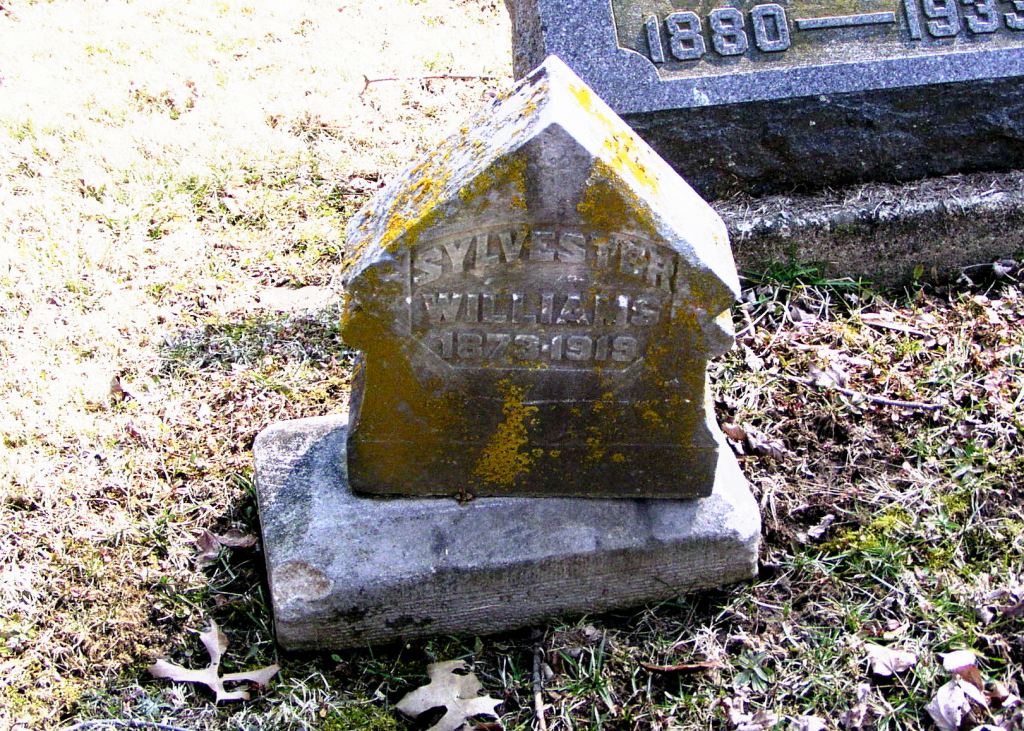
His CWGC headstone records that he served with the Canadian Overseas Railway Construction Corps. This is an error, which is consistent across many of the casualties of No. 2 Construction Battalion.[5] His family paid for the epitaph on his CWGC headstone: ‘Thou art gone dear son but not forgotten.’ The grave is also marked with a smaller, family stone.
The family marker on the grave of Private Sylvester Williams
Private Sylvester Williams is commemorated on Page 545 of the of the Canadian First World War Book of Remembrance; that page is displayed on 18 November.
The Canadian Book of Remembrance showing the entry for Private Sylvester Williams
His medals group comprises the British War Medal 1914-20, and the Victory Medal, which were dispatched to his mother, who also was also sent the Memorial Cross, the Memorial Scroll, and Memorial Plaque.
The grave of Private Sylvester WilliamsThe family marker on the grave of Private Sylvester WilliamsThe Canadian Book of Remembrance showing the entry for Private Sylvester Williams
Acknowledgements: Arne Trelvik and the Warren County Genealogical Society for the information about Sylvester William’s family and for the photographs of his grave.
Sources: Department of Soldiers’ Civil Re-Establishment. (May 1918). Report of the Work of the Invalided Soldiers’ Commission. Ottawa: J De L Taché. Ruck, C W. (1986). Canada’s Black Battalion: No.2 Construction, 1916-1920. Halifax: Society for the Protection and Preservation of Black Culture in Nova Scotia.
1. (Back) The tribute to the unit written by Calvin Ruck records 163 African-Americans, which is a slight understatement. Sylvester Williams is not recorded on the roll compiled by Ruck. Private Samuel Austin Williams is recorded as being from Harveysburg, Ohio, the address given by Sylvester Williams for his mother. In fact, Private Samuel Williams was from Port La Tour, Nova Scotia. It appears that Ruck has combined two soldiers in the roll. At least six other soldiers from Ohio are on that roll, most of whom were working in Detroit and enlisted in Windsor, Ontario:
931825 Private Thomas Cobby, Cincinatti 931404 Sergeant Edward White Hall, Cleveland 931762 Private Fred Davis, Columbus 931630 Private Fred Alvin Davis, Columbus 931577 Private Narvaez Smith, Columbus 931628 Private Edward Madison, Delaware
2. (Back) Augustus Williams (March 1833-24 July 1914) married Mary Jane (née Wornall) (March 1844-28 July 1924) on 5 September 1861. In addition to Sylvester and the children listed here, four children had been born and died by 1880. Harry (21 July 1871- 30 May 1931); Rosa V. (7 May 1875- 22 Jun 1928); Charles A. (8 June 1876-15 April 1919); Sarah Ann (4 December 1877-NK); Mary Elizabeth (later Simpson) (23 July 1879-15 May 1958); John H. (12 July 1883-15 December 1939); and Samuel (18 May 1885-21 January 1953). 3. (Back) Local records indicate that he served in the United States Army during the Spanish American War but this has not been verified. 4. (Back) Upon discharge all officers and soldiers passed to the control of the Commission if they required ‘medical treatment on account of their suffering from tuberculosis, epilepsy, paralysis or other diseases likely to be of long duration or incurable, or on account of their being mentally deficient or insane’. Department of Soldiers’ Civil Re-Establishment. (May 1918). Report of the Work of the Invalided Soldiers’ Commission. p 7. Ottawa: J De L Taché. 5. (Back) This will be the subject of a separate essay.


 Sacrifice